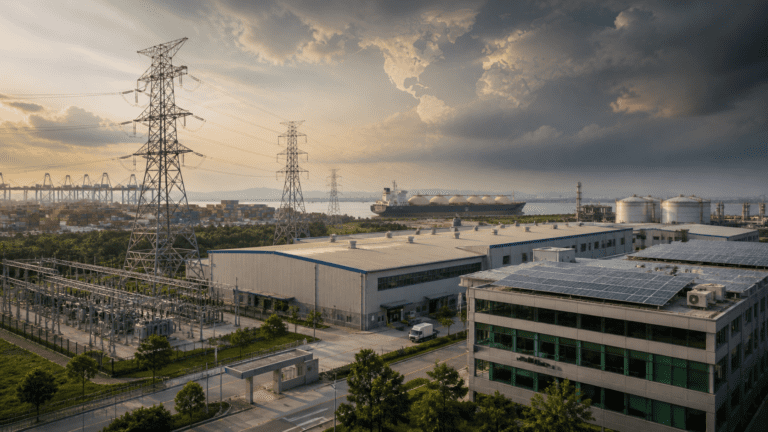
For manufacturers, factories, warehouses, retail chains, and commercial building owners in Malaysia, electricity is no longer just a background operating cost. It is becoming a business risk that needs closer attention.
Not every geopolitical tension affects fuel prices. However, when tensions involve oil and gas producing regions, coal exporters, Liquefied Natural Gas (LNG) supply, or major shipping routes, the impact can spread across the global energy market. When supply becomes uncertain, countries may compete harder to secure limited fuel, pushing prices higher.
For example, the Strait of Hormuz supplies about 20 million barrels per day of oil in 2024, equal to around 20% of global petroleum liquids consumption. Around one-fifth of global LNG trade also passed through the same route. This shows why disruptions in major energy routes can matter even to businesses far from the conflict area.
1) Why global tensions can affect local electricity prices
- Global tensions can disrupt the supply of key fuels such as oil, gas, LNG, and coal when the affected regions are connected to energy production or shipping routes.
- When supply becomes uncertain, countries and power producers may compete more aggressively to secure fuel. This can increase fuel prices and electricity generation costs.
- Higher fuel prices can increase the cost of electricity generation, especially for power systems that still depend on fossil fuels.
- Shipping delays, higher insurance costs, longer delivery routes, and currency movements can also add pressure to energy costs.
- Malaysia’s electricity generation mix has historically depended heavily on natural gas and coal, which means global fuel cost movement can indirectly affect local electricity generation costs.
Source: IEA – Malaysia
2) Why businesses need to pay attention to Malaysia’s tariff structure
- Malaysia’s electricity tariff structure is becoming more closely linked to actual generation costs, which makes energy planning more important for businesses.
- Under RP4, Malaysia’s new electricity tariff schedule is effective from 1 July 2025 to 31 December 2027.
Source: Suruhanjaya Tenaga – RP4 Tariff - The Automatic Fuel Adjustment, effective from July 2025, replaces the previous ICPT mechanism. When actual fuel cost is lower, users receive a rebate. When actual fuel cost is higher, a surcharge applies.
Source: Suruhanjaya Tenaga – IBR - Recent AFA movements show why businesses need to monitor electricity cost more closely. In January 2026, the AFA rate was -4.99 sen/kWh, meaning users received a rebate. By April 2026, the rebate had been reduced to -0.47 sen/kWh. In May 2026, AFA turned into a surcharge of +1.38 sen/kWh.
- For commercial and industrial users with high monthly consumption, even a small sen/kWh movement can become a significant operating cost.
3) Why manufacturing and commercial users are more exposed
- Manufacturing and commercial buildings usually consume electricity at a much higher and more consistent level compared to households.
- Their electricity usage is directly linked to daily operations, such as production lines, cooling systems, machinery, compressors, pumps, lighting, and long operating hours.
- When electricity costs increase, the impact is not limited to monthly utility bills. It can affect operating margins, product pricing, cash flow, and overall business competitiveness.
- Businesses with high daytime loads or demand spikes may feel the impact more strongly because their operations require steady and reliable electricity.
4) How solar helps reduce dependency on grid electricity
- Solar helps businesses generate part of their electricity on-site, reducing the amount of electricity purchased from the grid.
- This is especially useful for factories, warehouses, and commercial buildings that operate during the day, because solar generation usually matches daytime electricity usage.
- By lowering grid consumption, businesses can reduce their exposure to future electricity price volatility.
- Solar also allows unused rooftop space to become a productive energy asset that supports both cost control and sustainability goals.
- Malaysia’s Renewable Energy Roadmap aims to increase the renewable energy share in installed capacity to 31% by 2025 and 40% by 2035.
Source: SEDA – Malaysia Renewable Energy Roadmap
5) How battery storage and energy management add another layer of control
- Battery Energy Storage Systems, or BESS, can help businesses manage when and how electricity is used.
- For businesses with demand spikes from machinery, cooling systems, or production schedules, battery storage can support peak shaving and reduce pressure during high-demand periods.
- Battery storage can also help store excess solar energy for later use, improving the value of on-site solar generation.
- Together with energy monitoring and load management, businesses can better understand their consumption patterns and identify where savings can be achieved.
- TNB also highlights Time-of-Use options for eligible customers, where electricity rates vary based on usage periods.
Source: TNB Tariff
Conclusion
Global geopolitical tensions may seem far from daily business operations, but their impact can reach Malaysian companies through fuel prices, electricity generation costs, and tariff adjustments.
For manufacturing and commercial players, the key takeaway is simple: electricity cost control should not be reactive. Solar, battery storage, energy efficiency, and smarter load management can help businesses reduce exposure to future electricity price volatility while building a more resilient energy strategy.
Ready to make better use of your roof space?
Chat with us via WhatsApp at +60197502386 or email [email protected] to find out how solar can help reduce your daily energy usage.