
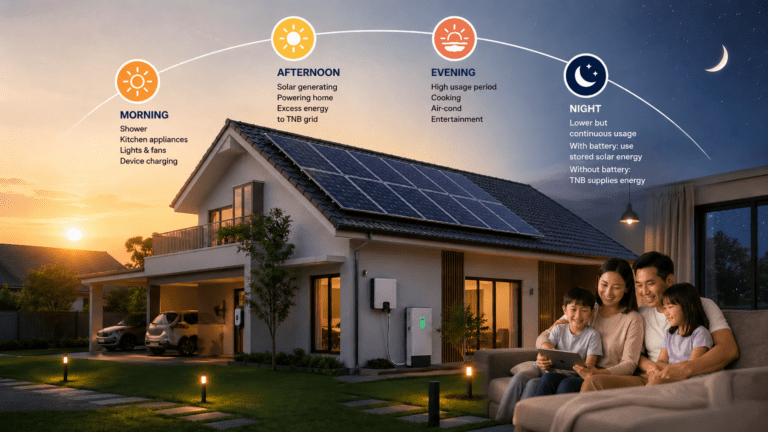
Electricity is part of almost every moment at home. From the morning alarm, hot shower, breakfast prep, air-cond, WiFi, fridge, TV, and phone charging before bedtime, your home is using electricity throughout the day.
According to TNB, household electricity consumption depends on family size, living habits, number and age of electrical appliances, and hours of usage. TNB also provides a Home Energy Calculator to help users estimate electricity use based on appliance usage.
That is why understanding your daily usage pattern matters. Once you know when your home uses the most electricity, it becomes easier to see where solar can help reduce your TNB bill.
The day usually begins with a quick rise in electricity usage.
Several appliances may be running at the same time, such as:
Suruhanjaya Tenaga lists common energy-using household products such as air-conditioners, refrigerators, fans, lamps, televisions, washing machines, microwave ovens, rice cookers, freezers, and electric ovens. This shows how everyday appliances can quickly add up when used together.
Once the sun comes up, your solar panels also begin generating electricity, helping offset part of your morning usage.
Even when nobody is home, electricity usage does not stop completely.
Some appliances continue running in the background, such as:
Afternoon is usually when solar panels perform at their best. During this period, your solar system can power these daytime loads directly.
Under Solar ATAP, TNB explains that your home will first consume the energy generated by your solar PV system. If the energy is not fully used, the excess can be supplied to the TNB grid.
So even when your family is at work or school, your roof is still helping to reduce your electricity cost.
For most families, evening is when electricity usage rises again.
Common evening loads include:
By this time, solar generation has already dropped because the sun is going down. This means your home may depend more on TNB electricity.
This is where battery storage can help. A solar + battery system stores extra solar energy generated during the day and releases it later when your home needs it most.
At night, electricity use slows down, but it does not become zero.
Common night-time loads include air-cond, refrigerator, WiFi router, night lights, phone charging, and security systems.
Without battery storage, this night-time electricity is usually drawn from the grid. When solar energy is insufficient, or at night when there is no sunlight, TNB will supply energy to the consumer.
For homeowners who want to use more of their own solar energy after sunset, battery storage can be added as an optional upgrade. It stores extra solar energy generated during the day and releases it later at night, helping reduce reliance on grid electricity during non-solar hours. Under the Solar ATAP guideline, BESS may also be incorporated as part of the solar PV installation, subject to relevant electrical and safety requirements.
Solar is not only about generating electricity during the day. It is about matching your energy system with how your household actually uses power, from morning to night.
For Malaysian homeowners, solar is not just a green upgrade. It is a practical way to take better control of daily electricity costs while making better use of the roof space you already have.
Ready to make better use of your roof space?
Chat with us via WhatsApp at +60-197502386 or email [email protected] to find out how solar can help reduce your daily energy usage.
Let our specialists assess your energy needs and recommend the ideal solution. Simply share your details, and our team will be in-touch shortly.