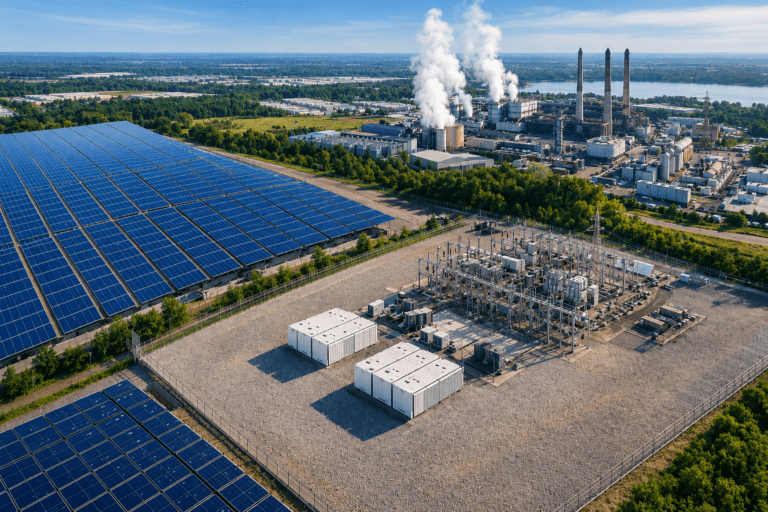
For many factory and commercial building owners, electricity is no longer just a utility cost. It affects production planning, operating margins, and long-term competitiveness. At the same time, businesses face growing pressure to show measurable sustainability performance.
In Malaysia, this shift is happening alongside the National Energy Transition Roadmap, which puts more focus on renewable energy, energy efficiency, and a more resilient energy future. For industrial businesses, solar and battery storage support cost control, efficiency, and stronger ESG performance.
1) Solar helps businesses take control of energy costs
- For factories, manufacturers, and commercial sites with strong daytime operations, solar can reduce the amount of electricity purchased from the grid.
- This is especially useful for businesses with machinery, cooling systems, production lines, or heavy daytime loads.
- By generating electricity on-site, solar gives your business more control over a major operating cost.
- This matters even more now, as Malaysia’s Solar ATAP scheme, introduced from 1 January 2026, gives businesses a clearer framework to adopt rooftop solar for self-consumption
2) Use battery storage to “shape” how and when you use power
- Solar generates electricity during the day, but battery storage helps businesses decide when that energy can be used more effectively.
- It stores excess energy for later use instead of relying only on real-time solar generation.
- For plants with maximum demand spikes or evening operations, batteries can be charged during day time and discharged during peak periods to reduce your load profile and expensive demand charges.
- Battery storage can act like a fast backup power source for your most important machines during brief power cuts or voltage drops, helping your production line keep running while reducing the risk of wasted product, rework, and unplanned overtime.
3) Turn ESG from marketing into measurable performance
- This is becoming more important as ESG expectations are moving beyond broad statements and into more formal disclosure requirements
- Malaysia’s NSRF, launched by the Securities Commission, adopts IFRS S1 and S2 as the baseline for sustainability reporting, with a phased roll‑out for listed and large non‑listed companies.
- Bursa Malaysia is aligning its listing requirements with these standards, meaning more detailed, climate‑related disclosures will appear in annual reports over the next few years.
- With solar and batteries, businesses can track kWh generated, kWh stored and discharged, and tonnes of CO₂ avoided, turning ESG claims into hard data that can go straight into customer audits, bank discussions and sustainability reports.
4) Stronger ESG can support business growth and credibility
- ESG is no longer only about corporate image, it can influence how customers, financiers, investors, and supply-chain partners assess a business.
- Global buyers are already asking Malaysian suppliers how they manage climate risks, energy costs and emissions, especially those in energy‑intensive sectors.
- A business that can show real investments in renewable energy and better energy management looks more prepared, more resilient and less risky to customers, financiers and insurers.
- On top of that, MGTC’s Green Investment Tax Allowance (GITA) and Green Income Tax Exemption (GITE) continue to support qualifying green technology assets and projects, including renewable energy, improving project returns for early movers.
Final Thought: A Smarter Energy Move for Long-Term Business Value
For industrial businesses in Malaysia, solar and battery storage are becoming part of a smarter long-term business strategy. Beyond lowering electricity costs, they can help improve energy management, strengthen sustainability performance, and show that the business is preparing for a more demanding market environment.
Thinking of Going Solar / Solar + Battery?
Speak to TERA to find the right solution for your home, energy usage, and long-term savings goals.
Got questions? Reach out to us via WhatsApp at +60-197502386 or email us at [email protected] to kick-start your solar journey.
You May Also Find This Helpful :
Battery Energy Storage System (BESS): Storing potential for a greener future
How solar, batteries, and smart systems work together
Solar ATAP 2026: Powering Business Competitiveness
From rooftop to ROI: a step-by-step guide to commercial solar installation in Malaysia