
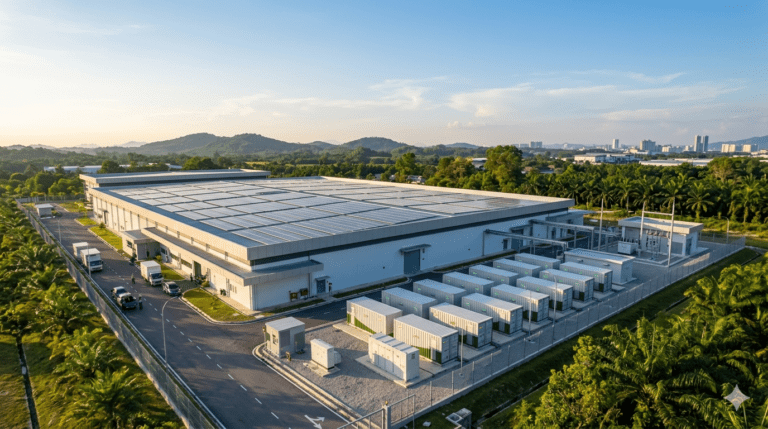
Building a More Resilient Data Centre in Malaysia with Solar and Battery Storage

Malaysia’s data centre market is growing quickly, but growth also brings a bigger energy challenge. For owners and operators, the question is no longer just how to build more capacity, but how to manage electricity cost, grid pressure, and sustainability expectations at the same time.

That matters even more as MIDA has highlighted that data centre energy consumption in Malaysia could rise to over 5,000MW by 2035, representing around 40% of Peninsular Malaysia’s current power capacity. For data centres, energy is no longer just a utility cost. It is becoming a strategic factor in uptime, cost control, and sustainability performance. 


   1) Why energy resilience matters more today

  • Data centres operate 24 hours a day, 7 days a week, unlike normal commercial buildings that reduce electricity usage after office hours.
  • Servers, cooling systems, monitoring equipment, security systems, and network infrastructure need continuous power to keep operations stable.
  • This makes electricity directly linked to uptime, service reliability, and operational stability.
  • As more facilities are developed in Malaysia, operators will face greater pressure to show that their sites are reliable, energy-efficient, and environmentally responsible.
  • Malaysia’s Guideline for Sustainable Development of Data Centre reflects this shift by focusing on measurable performance indicators such as Power Usage Effectiveness (PUE), Carbon Usage Effectiveness (CUE), and Water Usage Effectiveness (WUE).


   2) Maximum demand for data centres

  • For data centres, electricity cost is not only about total energy consumption. Peak demand also matters.
  • TNB defines Maximum Demand as the highest recorded electrical demand in kilowatts within a particular month, based on the customer’s peak usage.
  • Cooling demand, IT load, equipment upgrades, and future expansion can increase the power required from the grid at peak periods.
  • A high maximum demand can affect electricity cost, grid capacity planning, and long-term site scalability.
  • This is why operators need to understand when demand peaks, what causes those peaks, and how they can be managed more efficiently.


3) Why more data centres in Malaysia are looking at solar

  • Solar gives data centres a way to support part of their electricity needs through on-site generation, instead of relying entirely on grid supply.
  • In Malaysia, the Solar ATAP framework allows eligible non-domestic users to install solar PV for self-consumption, making it relevant for facilities that want more control over part of their daytime electricity use.
  • Solar should not be positioned as a full replacement for grid power. Its stronger role is to reduce part of daytime grid consumption and support green energy usage.
  • This makes solar a practical business tool for improving energy cost planning, reducing grid reliance, and strengthening sustainability performance.
 

4) Why battery storage matters

  • Solar helps generate energy, while battery storage helps manage when that energy is used.
  • This matters because data centres continue operating at night and during periods of lower solar generation.
  • With the right design, batteries can store solar energy or support selected usage during higher-demand periods.
  • Time of Use tariff structures also make energy timing more important, as TNB’s Enhanced Time of Use scheme includes Peak, Mid-Peak, and Off-Peak periods to encourage demand-side management.
  • This can help operators plan energy use more strategically while reducing the need to draw all electricity directly from the grid during critical demand periods.
 

5) What solar and battery can do for a data centre

  • Data centres still require strong grid connection, UPS systems, backup generators, cooling redundancy, and proper engineering design.
  • The more realistic role of solar and battery storage is to support the site’s wider energy strategy.
  • Solar can reduce part of daytime grid consumption, while battery storage can improve how selected energy loads are managed.
  • This gives operators more control over energy usage while supporting sustainability and long-term energy planning.
  • Put simply, solar and battery may not run the whole data centre, but they can make its energy strategy more resilient, flexible, and future-ready.
 

Final takeaway

For data centres in Malaysia, energy strategy should not be treated as something to optimise later. A facility that operates 24/7 needs a stronger plan for electricity cost, maximum demand, grid dependency, and sustainability performance.

Solar provides cleaner and potentially lower-cost on-site energy, while battery storage helps improve how that energy is used. Together, they can turn energy planning into a strategic advantage.


Planning a new data centre or preparing for future expansion?

Chat with us via WhatsApp at +60-197502386 or email [email protected] to find out how solar can help reduce your daily energy usage.


Thinking of going solar?

Let our specialists assess your energy needs and recommend the ideal solution. Simply share your details, and our team will be in-touch shortly.

Contact Form