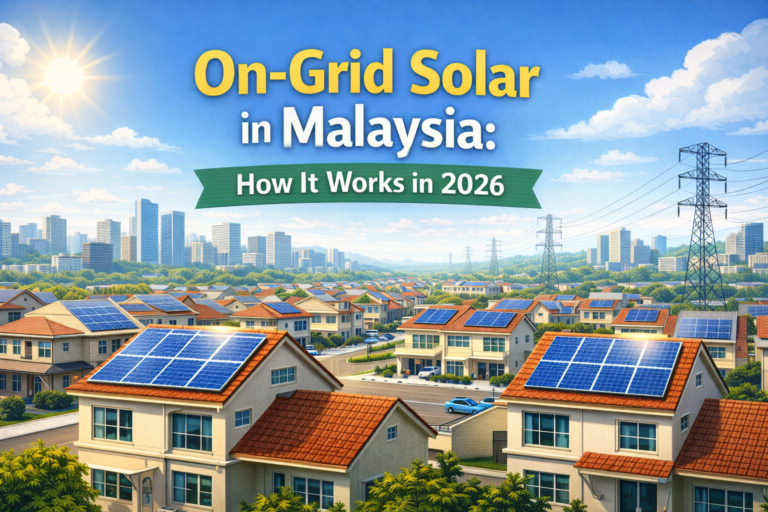
If you’ve been researching solar in Malaysia, you’ve probably seen terms like on-grid, export credits, SELCO, and Solar ATAP. It can feel confusing, but the concept is simple.
Here’s how an on-grid system works in 2026, how Solar ATAP vs SELCO fits in, and when a battery is suitable.
1) What is an On-Grid Solar System?
An on-grid solar system is a rooftop solar setup connected to the TNB grid.
During the day:
- Your panels generate electricity
- Your home uses solar first
- If solar is not enough, you automatically draw from TNB
At night or on cloudy days:
- Solar generation drops or none
- Your home pulls from TNB as usual
Important note:
- During a TNB blackout, standard on-grid solar will shut down automatically (anti-islanding protection/ power cut safety shutdown)
- To power your house/building during blackout, the system must be paired with a Battery Energy Storage System (BESS)
2) The Key Schemes in 2026: Solar ATAP vs SELCO
In 2026, new residential on-grid applications generally fall into two main directions:
Solar ATAP (Export Allowed)
- You can export excess solar to TNB
- Excess energy becomes bill credits
- Credits are typically used within the same billing cycle
- Residential limits commonly go up to:
- 5 kW AC for single-phase power supply
- 15 kW AC for three-phase power supply
- If a homeowner intends to install above these limits, additional approval is required : Certificate of Completion and Compliance (CCC)
- Refer to the latest guidelines from (https://www.st.gov.my)
SELCO (Self-Consumption, No Export)
- Designed for self-consumption only
- Excess solar energy cannot be exported to TNB
- System sizing becomes more important for correct generation and wastage
- Oversizing can reduce ROI / payback value, because under SELCO surplus energy is not credited
3) What’s in a Typical On-Grid System?
Most home systems include:
- Solar panels (PV modules) to generate DC electricity
- Inverter to convert DC to AC and sync with the grid
- Bi-directional meter (for export schemes like ATAP) to track:
- Import (from grid)
- Export (to grid)
4) How It Works Day-to-Day
Think of it as “solar first” every time the sun is out.
Daytime
- Solar powers your home first
- Example: if your home uses 2 kWh and solar produces 5 kWh:
- 2 kWh powers your house
- 3 kWh becomes surplus
Surplus handling
- Under ATAP: surplus can be exported and becomes bill credits (within that month)
- Under SELCO: surplus isn’t credited, it’s important to install the right system size, to avoid wastage and maximise value from your investment
Night / cloudy
- Your home draws from TNB as usual
Blackout or Disruption
- Standard on-grid shuts down unless you have hybrid system of solar PV + battery storage
5) Quick Tips Before You Install in 2026
- Choose the right programme: ATAP (export) vs SELCO (no export)
- Size the system properly: oversizing can reduce ROI if surplus isn’t credited
- Check your power supply: single-phase vs three-phase affects allowable system size
- Assess roof conditions: shading, orientation, structure matters
- Choose experienced installers for smooth approvals,safety compliance and after sales support
Thinking of Going Solar / Solar + Battery?
Speak to TERA to find the right solution for your home, energy usage, and long-term savings goals.
Got questions? Reach out to us via WhatsApp at +60-197502386 or email us at [email protected] to kick-start your solar journey.
You May Also Find This Helpful :
Battery Energy Storage System (BESS): Storing potential for a greener future
How solar, batteries, and smart systems work together
Solar ATAP 2026: What Homeowners Need to Know
Solar ATAP 2026: Powering Business Competitiveness
From rooftop to ROI: a step-by-step guide to commercial solar installation in Malaysia