
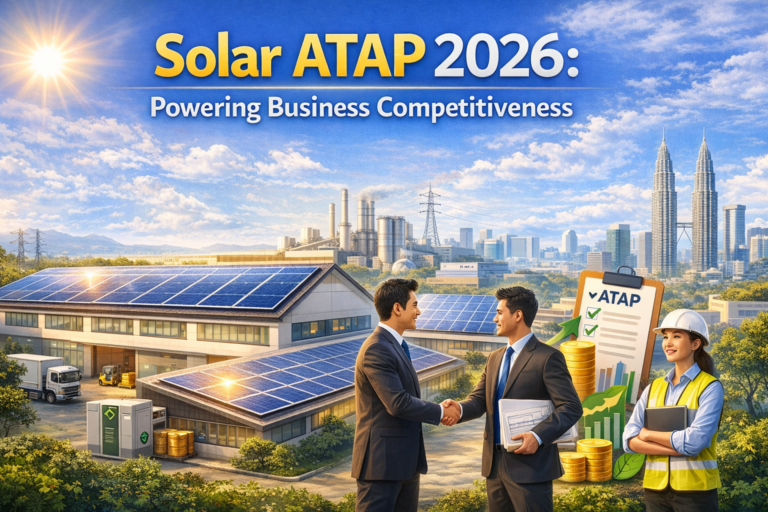
As the global economy continues to evolve, businesses are increasingly seeking ways to stay competitive. By generating their own energy, companies can offset electricity costs, reduce reliance on the grid, lower emissions, increase EGS scoring, and take the first step toward a more sustainable future.
In Malaysia, the electricity generation landscape is still dominated by fossil fuels. According to the Energy Commission (EC), below are the source breakdown :
Source | Share(%) |
Coal | 59.7 |
Natural Gas | 32.7 |
Hydro | 4.7 |
Solar | 2.4 |
Other | 0.5 |
(Data duration : 1st January to 30th June 2025)
Despite Malaysia’s abundant sunlight, solar adoption remains relatively low. However, the government is promoting solar energy through initiatives such as Solar ATAP, which encourages private solar generation and self-consumption.
By generating and consuming solar energy on-site, businesses can reduce reliance on grid-supplied electricity, especially during periods of higher demand or supply constraints. This improves cost control and budgeting, because a portion of energy consumption is secured internally. At the same time, using solar helps lower greenhouse gas emissions from electricity use, supporting measurable sustainability goals that many clients, investors, and supply chains increasingly expect.
Solar ATAP is suitable for businesses with significant daytime electricity usage. It is especially relevant for:
Businesses that operate mainly during the day and have stable energy consumption patterns are better positioned to benefit from rooftop solar under Solar ATAP. This can be paired with a Battery Energy Storage System (BESS) to shave peak demand from the grid and provide backup power, ensuring uninterrupted operations.
Businesses with high power demand during the day can always pair a solar PV System with BESS to shave peak demand and eventually save maximum demand charges. BESS also can serve as your backup power.
Start your business’s green journey by assessing your energy needs and exploring potential savings through rooftop solar. Choosing the right solution and leveraging Solar ATAP initiatives are key to staying competitive.
Solar ATAP is an exciting opportunity for Malaysian businesses to explore renewable energy. By understanding energy profiles and planning accordingly, businesses can take informed steps toward cost savings, resilience, and sustainability. While it is still a relatively new program, its potential to reduce reliance on the grid and support environmental goals is clear. Businesses can also size their solar system according to their maximum demand, allowing for a solution that better matches operational needs.
Visit the TERA website to explore trusted installers and financing options tailored to Malaysian homeowners.
Got questions? Reach out to us via WhatsApp at +60-197502386 or email us at [email protected] to kick-start your solar journey.
You May Also Find This Helpful :
Unlock Malaysian Government Incentives: Tax Reliefs & Schemes for Commercial Solar Adoption
Reduce Operating Costs & Boost Your Bottom Line: The Financial Case for Commercial Solar in Malaysia
On-Grid Solar in Malaysia: How It Works in 2026
TNB’s new tariff starts 1 July 2025: Here’s why it’s the right time to explore solar
Malaysia’s SELCO Guidelines 2025: A Comprehensive Guide to Solar PV Installation with Solar Panels
Optimising Energy Consumption Through SELCO and NEM
From rooftop to ROI: a step-by-step guide to commercial solar installation in Malaysia
Let our specialists assess your energy needs and recommend the ideal solution. Simply share your details, and our team will be in-touch shortly.